
Hackmanite
A variety of Sodalite
This page kindly sponsored by John Kashuba


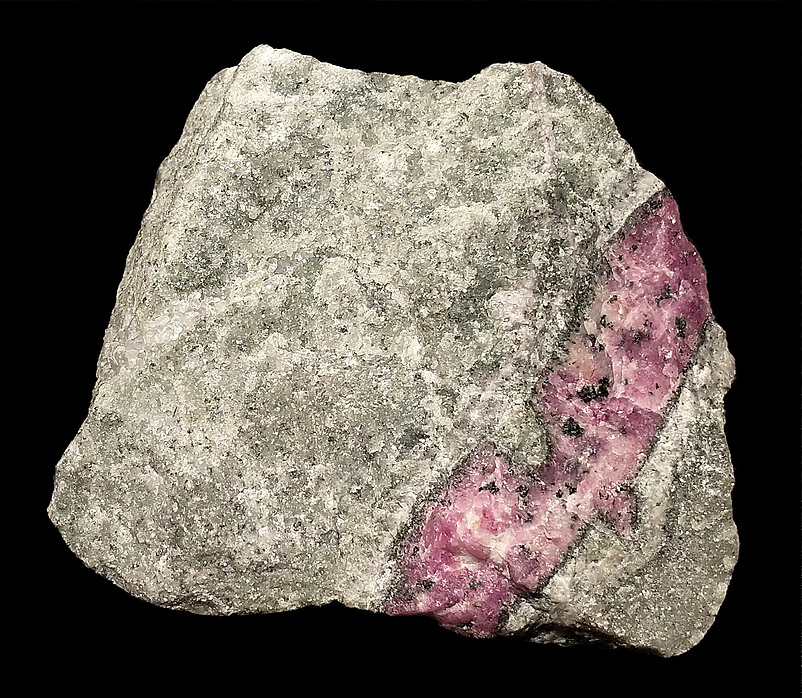

About Hackmanite

Victor Axel Hackman
Formula:
Na8Al6Si6O24Cl2
Colour:
Pink, purple, blue, white, colourless
Name:
For Finnish geologist Victor Axel Hackman (27 April 1866, Wyborg, Grand Duchy of Finland, Russian Empire - 26 November 1941, Helsinki, Finland). Professor at University of Helsinki (Helsingfors) and geologist with the Finnish Geological Survey. He accompanied Wilhelm Ramsay in the Finnish Kola expedition of 1891-1892, during which a rock called tawite, mainly consisting of S-bearing sodalite and aegirine, was recovered (Ramsay, 1898).
A variety of sodalite showing tenebrescence (reversible photochromism). Hackmanite can be a deep pink, blue or purple but quickly fades to colourless when exposed to sunlight. The original colour can be restored quickly by exposure to short-wave ultraviolet light, or more slowly by storing it in a dark space.
It typically contains some S, but not always enough to be detectable with EDS (<1%). The S content is related to its tenebresence.
Hackmanite shows orange coloured photoluminescence in UV light, exhibits a purple-red colour subsequently to UV irradiation or after cracking, bleaches within minutes to hours in visible light, and usually recovers colour in darkness.
The change in the colour of hackmanite in photochromism is caused by the joint action of the F-center and the oxygen hole centres. The change in the UV-Vis spectra may be caused by the superposition of two peaks. Under 365 nm UV excitation, the peak of fluorescence spectra of 662 nm is related to the 2∏g→2∏u transition of S2−, the blue emission at 441 nm is caused by the 3P0.1→1S0 transition of s2 ions (Pb2+, Tl+, Sn2+ Sb2+) , and at 541 nm is caused by the Mn2+ center. The results are helpful in deepening the understanding of photochromism, fluorescence mechanism, and its structure, expanding the application of hackmanite.
Originally described from Tavaiok river (=Tawajok in Ramsey, 1898; Tawa in Borgström 1901 and 1903) valley, Lovozero (Lujavr-Urt in Ramsay, 1898; Lujaur-Urt in Borgström, 1901 and 1903) Massif, Kola Peninsula, Murmanskaja Oblast', Northern Region, Russia (Ramsey, 1898; Borgström, 1901 and 1903).
 Visit gemdat.org for gemological information about Hackmanite.
It typically contains some S, but not always enough to be detectable with EDS (<1%). The S content is related to its tenebresence.
Hackmanite shows orange coloured photoluminescence in UV light, exhibits a purple-red colour subsequently to UV irradiation or after cracking, bleaches within minutes to hours in visible light, and usually recovers colour in darkness.
The change in the colour of hackmanite in photochromism is caused by the joint action of the F-center and the oxygen hole centres. The change in the UV-Vis spectra may be caused by the superposition of two peaks. Under 365 nm UV excitation, the peak of fluorescence spectra of 662 nm is related to the 2∏g→2∏u transition of S2−, the blue emission at 441 nm is caused by the 3P0.1→1S0 transition of s2 ions (Pb2+, Tl+, Sn2+ Sb2+) , and at 541 nm is caused by the Mn2+ center. The results are helpful in deepening the understanding of photochromism, fluorescence mechanism, and its structure, expanding the application of hackmanite.
Originally described from Tavaiok river (=Tawajok in Ramsey, 1898; Tawa in Borgström 1901 and 1903) valley, Lovozero (Lujavr-Urt in Ramsay, 1898; Lujaur-Urt in Borgström, 1901 and 1903) Massif, Kola Peninsula, Murmanskaja Oblast', Northern Region, Russia (Ramsey, 1898; Borgström, 1901 and 1903).
Visit gemdat.org for gemological information about Hackmanite.Unique Identifiers
Mindat ID:
1789 (as Hackmanite)
3701 (as Sodalite)
3701 (as Sodalite)
Long-form identifier:
mindat:1:1:1789:9 (as Hackmanite)
mindat:1:1:3701:9 (as Sodalite)
mindat:1:1:3701:9 (as Sodalite)
Physical Properties of Hackmanite
Colour:
Pink, purple, blue, white, colourless
Chemistry of Hackmanite
Mindat Formula:
Na8Al6Si6O24Cl2
Element Weights:
Other Language Names for Hackmanite
Common Associates
Associations Based on Photo Data:
| 117 photos of Hackmanite associated with Richterite | Na(CaNa)Mg5(Si8O22)(OH)2 |
| 94 photos of Hackmanite associated with Calcite | CaCO3 |
| 61 photos of Hackmanite associated with Sodalite | Na4(Si3Al3)O12Cl |
| 34 photos of Hackmanite associated with Phlogopite | KMg3(AlSi3O10)(OH)2 |
| 30 photos of Hackmanite associated with Uraninite | UO2 |
| 30 photos of Hackmanite associated with Johachidolite | CaAlB3O7 |
| 28 photos of Hackmanite associated with Albite | Na(AlSi3O8) |
| 24 photos of Hackmanite associated with 'Scapolite' | |
| 20 photos of Hackmanite associated with Feldspar Group | |
| 20 photos of Hackmanite associated with Nepheline | Na3K(Al4Si4O16) |
Fluorescence of Hackmanite
In hackmanite, green fluorescence is thought to be caused by partial substitution of Na+ by Mn, while partial substitution of Al3+ by Fe3+ leads to red luminescence and orange fluorescence is caused by the S2− . Ce3+ causes the fluorescence spectra to show an emission peak around 340 nm, Eu2+ leads to violet fluorescence, and the s2-type ions are associated with blue fluorescence, while the association of Ti3+ with oxygen vacancies may also lead to blue fluorescence.
Other Information
Health Risks:
No information on health risks for this material has been entered into the database. You should always treat mineral specimens with care.
Internet Links for Hackmanite
mindat.org URL:
https://www.mindat.org/min-1789.html
Please feel free to link to this page.
Please feel free to link to this page.
Search Engines:
Mineral Dealers:
References for Hackmanite
Reference List:
Lee, O. Ivan (1936) A new property of matter: Reversible photosensitivity in hackmanite from Bancroft, Ontario. American Mineralogist, 21 (12) 764-776
Zahoransky, Teresa, Friis, Henrik, Marks, Michael A. W. (2016) Luminescence and tenebrescence of natural sodalites: a chemical and structural study. Physics and Chemistry of Minerals, 43 (7) 459-480 doi:10.1007/s00269-016-0810-0
Curutchet, Antton, Le Bahers, Tangui (2017) Modeling the Photochromism of S-Doped Sodalites Using DFT, TD-DFT, and SAC-CI Methods. Inorganic Chemistry, 56 (1) 414-423 doi:10.1021/acs.inorgchem.6b02323
Vuori, Sami, Colinet, Pauline, Lehtiö, Juha-Pekka, Lemiere, Arnaud, Norrbo, Isabella, Granström, Micael, Konu, Jari, Ågren, Göran, Laukkanen, Pekka, Petit, Laeticia, Airaksinen, Anu J., van Goethem, Ludo, Le Bahers, Tangui, Lastusaari, Mika (2022) Reusable radiochromic hackmanite with gamma exposure memory. Materials Horizons, 9 (11) 2773-2784 doi:10.1039/d2mh00593j
Colinet, Pauline; Byron, Hannah; Vuori, Sami; Lehtiö, Juha-Pekka; Laukkanen, Pekka; Van Goethem, Ludo; Lastusaari, Mika; Le Bahers, Tangui (2022) The structural origin of the efficient photochromism in natural minerals. Proceedings of the National Academy of Sciences, 119 (23). e2202487119 doi:10.1073/pnas.2202487119
Localities for Hackmanite
Showing 36 localities.
 symbol to view information about a locality.
The
symbol to view information about a locality.
The Locality List
 - This locality has map coordinates listed.
- This locality has estimated coordinates.
ⓘ - Click for references and further information on this occurrence.
? - Indicates mineral may be doubtful at this locality.
- This locality has map coordinates listed.
- This locality has estimated coordinates.
ⓘ - Click for references and further information on this occurrence.
? - Indicates mineral may be doubtful at this locality.
 - Good crystals or important locality for species.
 - World class for species or very significant.
(TL) - Type Locality for a valid mineral species.
(FRL) - First Recorded Locality for everything else (eg varieties).
- World class for species or very significant.
(TL) - Type Locality for a valid mineral species.
(FRL) - First Recorded Locality for everything else (eg varieties).
All localities listed without proper references should be considered as questionable.
Afghanistan | |
| [www.thamesvalleyminerals.com] |
| Lavinsky (n.d.) |
| RWMW Collection |
| MIM Museum collection |
Canada | |
| Lee (1936) +1 other reference |
| [Bancroft & District Mineral Collecting ... |
| [Bancroft & District Mineral Collecting ... | |
| mineralogical association of Canada ... |
| Berger (2023) |
| Peterson (1983) |
Greenland | |
| Mandarino (2002) +1 other reference |
Guinea | |
| |
Myanmar | |
| Themelis (2008) |
| Harald Schillhammer collection | |
| Themelis (2008) |
| Themelis (2008) | |
| Themelis (2008) | |
| Sieghard Ellenberger data +1 other reference | |
| - (n.d.) +1 other reference | |
| Themelis (2008) | |
Norway | |
| Larsen et al. (2010) |
| Larsen et al. (2010) | |
| Larsen et al. (2010) |
| Nordrum (2010) |
Russia | |
| Lennikov et al. (2004) |
| Shlyukova Z.V. (1986) |
| Pavel M. Kartashov (n.d.) |
| Pekov (2000) | |
| Pavel M. Kartashov (n.d.) | |
| Pekov (1998) |
| Pekov (1998) |
| Ramsay (1899) +3 other references | |
USA | |
| AmMin 26:437 |
| Meyers et al. (1956) |
| van Rossen (2026) |
| Rutgers Univ. Bull. #5 |

Ladjuar Medam Richterite occurrence, Ladjuar Medam, Sar-e-Sang, Kuran wa Munjan District, Badakhshan, Afghanistan