
Ferro-anthophyllite
A valid IMA mineral species - grandfathered
This page is currently not sponsored. Click here to sponsor this page.
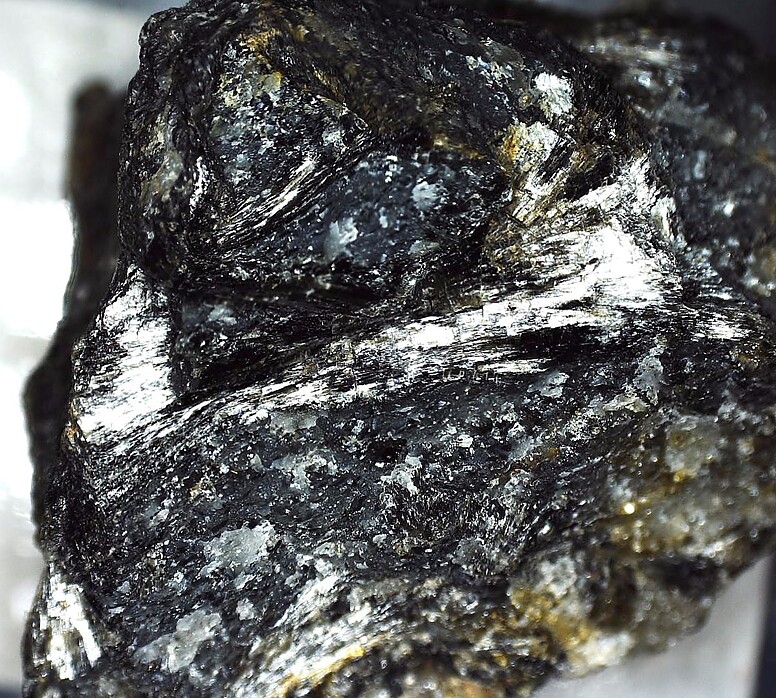
About Ferro-anthophyllite
Formula:
◻Fe2+2Fe2+5(Si8O22)(OH)2
The anthophyllite group are orthorhombic amphiboles in the magnesium-iron-manganese amphibole subgroup. The minerals in this root name group may have either Pnma or Pnmn (proto- prefixed name) space-group symmetry. The anthophyllite group's general composition is defined with A(Na+K+2Ca)<0.5 apfu and C(Al+Fe3++2Ti)<1 apfu.
Ferro-anthophyllite has a standard Pnma space-group symmetry and is defined with Fe as the dominant element both in the B and C positions.
Ferro-anthophyllite has a standard Pnma space-group symmetry and is defined with Fe as the dominant element both in the B and C positions.
Colour:
Clove-brown to dark brown, grey to white, pale green.
Lustre:
Vitreous
Hardness:
5½ - 6
Specific Gravity:
3.24
Crystal System:
Orthorhombic
Member of:
Name:
For its relationship to anthophyllite.
Type Locality:
Polymorph of:
Unique Identifiers
Mindat ID:
1464
Long-form identifier:
mindat:1:1:1464:5
IMA Classification of Ferro-anthophyllite
Approved, 'Grandfathered' (first described prior to 1959)
IMA status notes:
Redefined by the IMA
IMA Formula:
◻Fe2+2Fe2+5Si8O22(OH)2
First published:
1921
Approval history:
Redefined IMA 2012 s.p.
Classification of Ferro-anthophyllite
9.DD.05
9 : SILICATES (Germanates)
D : Inosilicates
D : Inosilicates with 2-periodic double chains, Si4O11; Orthoamphiboles
9 : SILICATES (Germanates)
D : Inosilicates
D : Inosilicates with 2-periodic double chains, Si4O11; Orthoamphiboles
14.19.4
14 : Silicates not Containing Aluminum
19 : Silicates of Fe
14 : Silicates not Containing Aluminum
19 : Silicates of Fe
Mineral Symbols
As of 2021 there are now IMA–CNMNC approved mineral symbols (abbreviations) for each mineral species, useful for tables and diagrams.
Please only use the official IMA–CNMNC symbol. Older variants are listed for historical use only.
Please only use the official IMA–CNMNC symbol. Older variants are listed for historical use only.
| Symbol | Source | Reference for Standard |
|---|---|---|
| Fath | IMA–CNMNC | Warr, L.N. (2021). IMA–CNMNC approved mineral symbols. Mineralogical Magazine, 85(3), 291-320. doi:10.1180/mgm.2021.43 |
| Fath | Whitney & Evans (2010) | Whitney, D.L. and Evans, B.W. (2010) Abbreviations for names of rock-forming minerals. American Mineralogist, 95, 185–187 doi:10.2138/am.2010.3371 |
Physical Properties of Ferro-anthophyllite
Vitreous
Colour:
Clove-brown to dark brown, grey to white, pale green.
Streak:
White to greyish-white.
Hardness:
5½ - 6 on Mohs scale
Tenacity:
Flexible
Density:
3.24 g/cm3 (Measured)
Chemistry of Ferro-anthophyllite
Mindat Formula:
◻Fe2+2Fe2+5(Si8O22)(OH)2
The anthophyllite group are orthorhombic amphiboles in the magnesium-iron-manganese amphibole subgroup. The minerals in this root name group may have either Pnma or Pnmn (proto- prefixed name) space-group symmetry. The anthophyllite group's general composition is defined with A(Na+K+2Ca)<0.5 apfu and C(Al+Fe3++2Ti)<1 apfu.
Ferro-anthophyllite has a standard Pnma space-group symmetry and is defined with Fe as the dominant element both in the B and C positions.
The anthophyllite group are orthorhombic amphiboles in the magnesium-iron-manganese amphibole subgroup. The minerals in this root name group may have either Pnma or Pnmn (proto- prefixed name) space-group symmetry. The anthophyllite group's general composition is defined with A(Na+K+2Ca)<0.5 apfu and C(Al+Fe3++2Ti)<1 apfu.
Ferro-anthophyllite has a standard Pnma space-group symmetry and is defined with Fe as the dominant element both in the B and C positions.
Element Weights:
Elements listed:
Crystallography of Ferro-anthophyllite
Crystal System:
Orthorhombic
Class (H-M):
mmm(2/m2/m2/m) - Dipyramidal
Space Group:
Pnma
Cell Parameters:
a = 18.686(7) Å, b = 18.358(20) Å, c = 5.336(2) Å
Ratio:
a:b:c = 1.018 : 1 : 0.291
Unit Cell V:
1,830.45 ų (Calculated from Unit Cell)
Z:
4
Comment:
For synthetic sample with Fe:Mg = 6:1 (Popp et al., 1976).
Geological Environment
Paragenetic Mode(s):
| Paragenetic Mode | Earliest Age (Ga) |
|---|---|
| Stage 3a: Earth’s earliest Hadean crust | >4.50 |
| 9 : Lava/xenolith minerals (hornfels, sanidinite facies) | |
| Near-surface Processes | |
| 26 : Hadean detrital minerals | |
| Stage 5: Initiation of plate tectonics | <3.5-2.5 |
| 40 : Regional metamorphism (greenschist, amphibolite, granulite facies) |
Type Occurrence of Ferro-anthophyllite
General Appearance of Type Material:
Splintery-fibrous masses, with fibers to 6 cm in length.
Place of Conservation of Type Material:
The IMA does not designate any type material; the type description mentions the United States National
Museum (Cat. No. 93998).
Museum (Cat. No. 93998).
Associated Minerals at Type Locality:
Synonyms of Ferro-anthophyllite
Other Language Names for Ferro-anthophyllite
Dutch:Ferro-anthophylliet
Japanese:鉄直閃石
Russian:Ферроантофиллит
Simplified Chinese:铁直闪石
Spanish:Feranthophyllita
Varieties of Ferro-anthophyllite
| Aluminian Ferroanthophyllite | A discontinued amphibole name. |
Relationship of Ferro-anthophyllite to other Species
Member of:
Other Members of Anthophyllite Root Name Group:
| Anthophyllite | ◻Mg2Mg5(Si8O22)(OH)2 | Orth. mmm(2/m2/m2/m) : Pnma |
| Proto-anthophyllite | ◻Mg2Mg5(Si8O22)(OH)2 | Orth. mmm(2/m2/m2/m) : Pnnm |
| Proto-ferro-anthophyllite | ◻Fe2+2Fe2+5(Si8O22)(OH)2 | Orth. mmm(2/m2/m2/m) |
| 'Sodic-ferro-anthophyllite' | NaFe2+2Fe2+5(AlSi7O22)(OH)2 | Orth. |
Forms a series with:
Related Minerals - Strunz-mindat Grouping
| 9.DD.05 | Suenoite | ◻Mn2+2Mg5Si8O22(OH)2 |
| 9.DD.05 | Proto-ferro-anthophyllite | ◻Fe2+2Fe2+5(Si8O22)(OH)2 |
| 9.DD.05 | Proto-ferro-suenoite | ◻Mn2+2(Fe2+5)(Si8O22)(OH)2 |
| 9.DD.05 | Papikeite | NaMg2(Mg3Al2}(Al3Si5O22)(OH)2 |
| 9.DD.05 | Gedrite | ◻Mg2(Mg3Al2)(Al2Si6O22)(OH)2 |
| 9.DD.05 | Holmquistite | ◻Li2(Mg3Al2)(Si8O22)(OH)2 |
| 9.DD.05 | 'Sodic-anthophyllite' | {Na}{Mg2}{Mg5}(AlSi7O22)(OH)2 |
| 9.DD.05 | 'Sodic-ferro-anthophyllite' | NaFe2+2Fe2+5(AlSi7O22)(OH)2 |
| 9.DD.05 | Ferro-papikeite | NaFe2+2(Fe2+3Al2)(Si5Al3O22)(OH)2 |
| 9.DD.05 | Proto-anthophyllite | ◻Mg2Mg5(Si8O22)(OH)2 |
| 9.DD.05 | Ferro-gedrite | ◻Fe2+2(Fe2+3Al2)(Al2Si6O22)(OH)2 |
| 9.DD.05 | 'Ferri-holmquistite' | ◻{Li2}{Mg3Fe3+2}(Si8O22)(OH)2 |
| 9.DD.05 | Ferro-ferri-holmquistite | ◻Li2(Fe2+3Fe3+2)(Si8O22)(OH)2 |
| 9.DD.05 | Ferro-holmquistite | ◻Li2(Fe2+3Al2)(Si8O22)(OH)2 |
| 9.DD.05 | Anthophyllite | ◻Mg2Mg5(Si8O22)(OH)2 |
Other Information
Thermal Behaviour:
Before the blowpipe the mineral fuses at a moderately high temperature to a black strongly magnetic slag. In the borax bead it reacts for iron and when fused with a large excess of sodium carbonate it reacts for manganese. Heated in a closed tube to a high temperature, it yields a small amount of water.
Notes:
Insoluble in acids.
Health Risks:
No information on health risks for this material has been entered into the database. You should always treat mineral specimens with care.
Internet Links for Ferro-anthophyllite
mindat.org URL:
https://www.mindat.org/min-1464.html
Please feel free to link to this page.
Please feel free to link to this page.
Search Engines:
External Links:
Mineral Dealers:
References for Ferro-anthophyllite
Reference List:
Shannon, Earl V. (1921) Description of ferroanthophyllite, an orthorhombic iron amphibole fromIdaho, with a note on the nomenclature of the anthophyllite group. Proceedings of the United States National Museum, 59 (2373). 397-401 doi:10.5479/si.00963801.2373.397
Seki, Yôtarô, Yamasaki, Masao (1957) Aluminian ferroanthophyllite from the Kitakami Mountainland, Northeastern Japan. American Mineralogist, 42 (7-8) 506-520
Popp, Robert K., Gilbert, M. Charles, Craig, James R. (1976) Synthesis and X-ray properties of Fe-Mg orthoamphiboles. American Mineralogist, 61 (11-12) 1267-1279
Localities for Ferro-anthophyllite
Showing 8 localities.
 symbol to view information about a locality.
The
symbol to view information about a locality.
The Locality List
 - This locality has map coordinates listed.
- This locality has estimated coordinates.
ⓘ - Click for references and further information on this occurrence.
? - Indicates mineral may be doubtful at this locality.
- This locality has map coordinates listed.
- This locality has estimated coordinates.
ⓘ - Click for references and further information on this occurrence.
? - Indicates mineral may be doubtful at this locality.
 - Good crystals or important locality for species.
 - World class for species or very significant.
(TL) - Type Locality for a valid mineral species.
(FRL) - First Recorded Locality for everything else (eg varieties).
- World class for species or very significant.
(TL) - Type Locality for a valid mineral species.
(FRL) - First Recorded Locality for everything else (eg varieties).
All localities listed without proper references should be considered as questionable.
China | |
| Yiming Zhao et al. (2006) +1 other reference |
Czech Republic | |
| Mücke et al. (2006) |
| Staněk (1991) +1 other reference |
India | |
| Patel et al. (2001) |
Romania | |
| minerals-of-the-carpathians.eu (2008) |
USA (TL) | |
| Rocks & Min. 70:262 |
| Gleba (2008) |
| www.agu.org/cgi-bin/wais?l=V21B-01 +1 other reference |
Quick NavTopAbout Ferro-anthophylliteUnique IdentifiersIMA Classification Classification Mineral SymbolsPhysical Properties Chemistry Crystallography Geological EnvironmentType Occurrence SynonymsOther LanguagesVarietiesRelationshipsStrunz-MindatOther InformationInternet Links References Localities Locality List

Stripåsen Mine, Häste ore field, Norberg, Västmanland County, Sweden