Proper Seating at the Piano
Overview
Good piano playing is only possible if we are comfortably seated at the piano. Therefore, at the beginning of every lesson and practice session, we arrange our piano bench so that it is the best height for playing and the best distance from the piano.
We adjust distance first. The best distance is one which allows our elbows to rest slightly in front of our center line when our hands are in a neutral position on the keyboard, with our hands in front of the elbows (i.e., not in front of the body or at the extremes of the keyboard).
The best height is one which both allows the elbow/upper arm to fall freely from the shoulder, and allows the forearm to be parallel to the floor when the forearm and hand are in their natural shape — the way they are when the hand is hanging at the side.
We sit on the front of the bench. Our torsos need to move from the hip joint, so the freedom of the hip joint is one thing to check to see if we are sitting in a good place. We sit far enough back on the bench to feel stable enough that we do not need to hold ourselves in place (it is not good to feel perched). We sit forward enough on the bench to allow the hip joint to move freely. If too much of our thighs are on the bench, our torso is forced back and it is difficult to move forward from the hip joint.
I do not want to give the impression that we are ever in a rigid position when we are playing. What I have described is less a position than a starting point for easy movement.
The upper arm feels quite easy and normal — not heavy or held, not lifted up or reaching forward. The forearm and hand are at ease, but not so relaxed they are heavy. They are in the shape they are in when hanging at the side, filled with the life that makes movement possible. The wrist is in one piece with the hand and forearm, not holding up or falling down.
A Few Illustration of Comfortable Seating at the Piano
Here you can see four before and after illustrations of solutions my students and I found so they can sit comfortably at the piano.
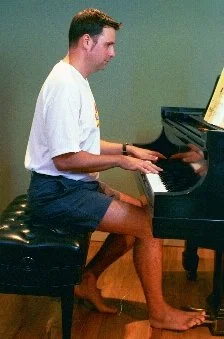
The bench is too low for Tom. His elbows are a little low – they would look lower, but his wrists are compensating by pulling up to give some support to the hands. It is admirable of the body to create balance even though it is deprived of the best conditions, but it is not ideal. His arm and hand are out of alignment at the wrist, the top knuckles are flattened out because of the high wrist, the fingers are also too extended.

Just two carpet samples, and, voilà! Tom’s forearms are parallel to the floor, his wrists are an easy one piece with the forearm and hand, and his knuckles have returned.

The bench is too high for Allison. It is at its top height because everyone else who uses this bench has to add things to it. When she sat down, she laughed because she felt so strange, and said, “I just don’t feel like my arms can rest down.” The longer she sat there, the more tempting it was for her torso to fall forward. Allison is very aware of her posture. If she were not, she would have given in to a slump to get a more solid feeling in her hands and forearms on the keys(or pull her wrists down. As it was, she had to hold herself in place to avoid slumping.

We lowered the bench, and lowered it some more, and finally she felt like she can rest down. She said, “All the strain is suddenly gone.”

The bench is too low for Laura and so is the floor! Her elbows are low and her heels are off the floor. Laura knows and likes the feeling of balancing forward toward the piano, so she is arching her back. If she were not used to the feeling of balancing forward, she would be slumped back because her heels are not on the floor.

Two carpet samples later, Laura’s elbows look like they are in the right place, but the heel situation is worse. This is compromising her back; which is still arched and her hands, which are reaching to be on the keyboard.

She is looking comfortable now with the addition of a small footrest. (Shoes with high heels can help in a similar way). Forearms and hands in one piece, wrists easy and part of the one - piece hand and forearm, and hands in their natural shape, the way they are when hanging at the side. Laura said, “It feels so much more comfortable when I’m set up right.”
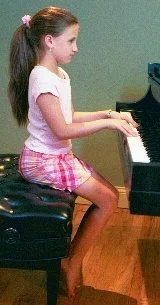
Catherine’s elbows are very low, so her wrists are lifting way up out of alignment with her hand and forearm. She is really reaching for the keys and her toes barely touch the floor
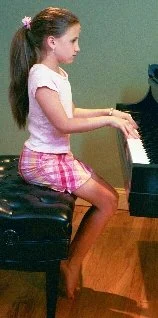
Catherine’s shoulders inched up as we took “before” pictures. We quickly took pictures, to illustrate this common reaction in the body to a low bench (the other common reaction is the wrists lifting up). Then we immediately began to adjust her seating, because she was so obviously uncomfortable.

The first thing we did was add things to the bench. And add them, and add them! We ended up with all four interlocking gym mats, with one carpet sample. The elbows, wrists, and shoulders look a lot better, but she is leaning back away from the piano because her feet have nothing to rest on.

Finally, she feels good. When we got the footstool in place she said, “I feel more relaxed and comfortable this way.”
Frequently asked questions
-
Always adjust the distance first. A bench that is too close may have the same effects as a bench that is too low (shoulders or wrists pulling up). A bench that is too far away may have the same effect as a bench that is too high (shoulders or wrists pulling down). Adjusting the distance first removes that confusion and allows you to judge the height accurately.
-
If I see forearms sloping up from elbows to keys, shoulders pulling up, or wrists pulling up, I always check first to see if they are sitting too close to the keyboard –the elbows should be a few inches in front of their center line. If the distance is good, .I raise the bench to see if the pianist can rest more comfortably on the keys.
-
If I see forearms sloping down from elbows to keys, shoulders pulling down, or wrists pulling down, I first check to see if they are sitting too far from the keyboard –the elbows should be a few inches in front of their center line. Once the distance looks right, I lower the bench to see if the pianist can rest more comfortably on the keys.
-
No. Some benches are higher than others, and some pianos are higher than others. We always look for the most comfortable position for the pianist.
-
Surprisingly, no! Depending on the time of day, you may sit slightly higher or lower. An Alexander Technique practitioner mentioned this so I decided to make no assumptions and keep looking at my bench height. Sure enough, I have noticed that I, and my students, will best sit slightly higher or lower depending on the time of day, how awake we are, or how fatigued our muscles are from recent exercise or stress.
-
Not necessarily. As your child grows, their proportions may change along with their height. And as anyone’s playing changes and grows, they may release in places so they need to sit higher, or firm up in other places, necessitating a lower seat.
Adding Height to the Bench
These interlocking gym mats can be moved quickly and easily, and they do not squish down the way pillows and cushions do. Their light weight makes them excellent for people who travel to different places for practicing, teaching, or accompanying. We use them at The Well-Balanced Pianist programs to quickly adjust bench height, and add height to practice piano benches


Carpet samples (or folded towels) are softer, and are more dignified too. They will eventually compress, though.
Adding Height to the Floor

People whose feet can not reach the floor will not be able to balance forward easily into the piano. There are some official-looking stools on the market for children with shorter legs, but other things work too. We found this footstool at an antiques show, and made the shorter footrests out of telephone books covered with sturdy cardboard boxes. Pro tip: when the height under the feet is good, the pianist will breathe more deeply and move more easily from the hips.
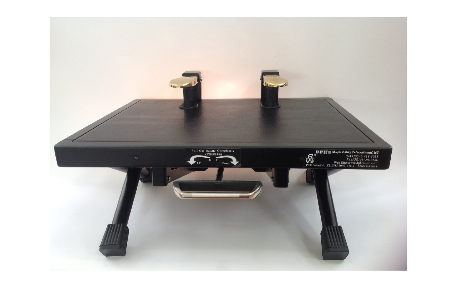
You can also find pedal extenders on the market. This gives children whose legs would otherwise dangle above the pedals the chance to experience the full range of sounds the piano can make, while sitting advantageously.
Our local piano teachers group uses this PE-2 Pedal Extender for our recitals and competitions