
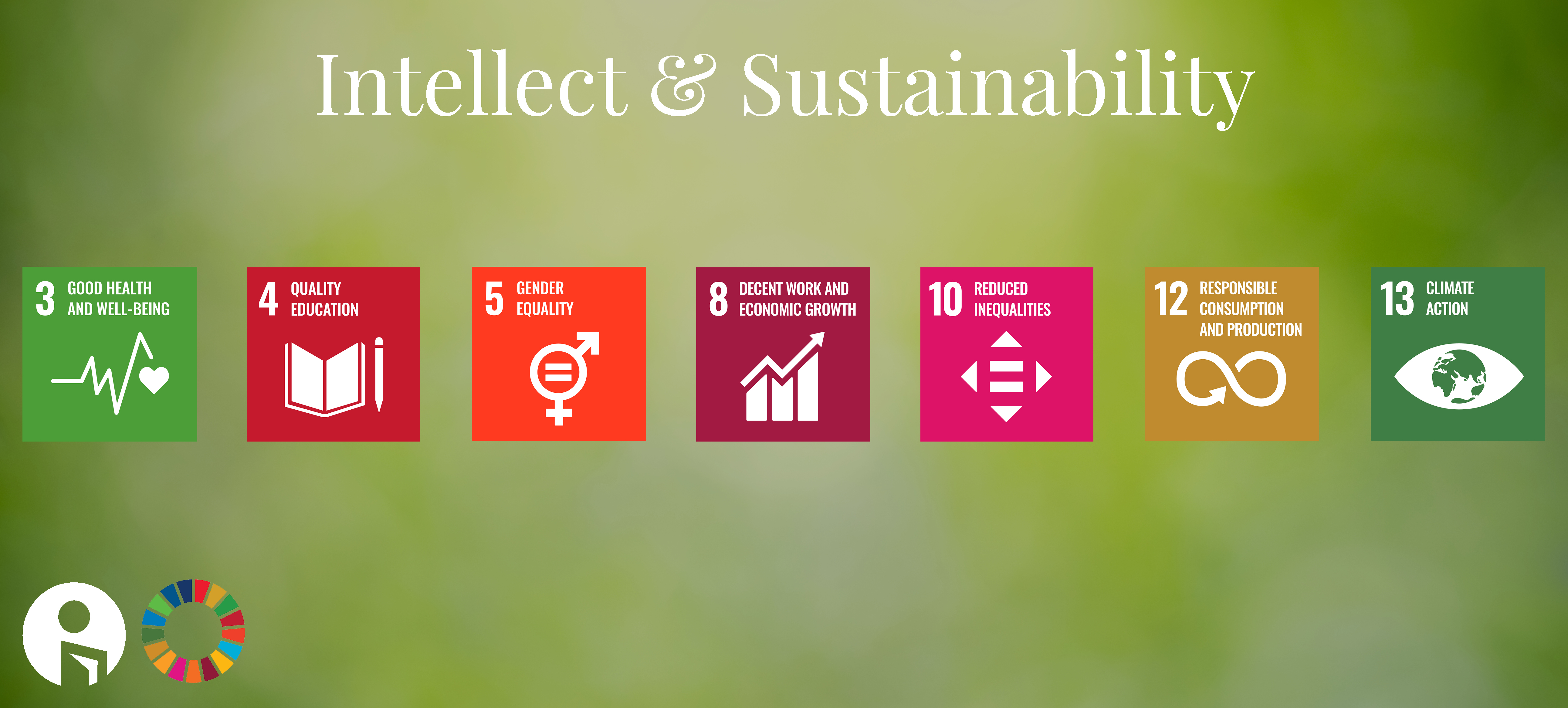
UNESCO Sustainable Development Goals
At Intellect, we are aware of the urgent global action required to keep temperatures below the two-degree threshold outlined by the Paris Agreement, and we are committed to adopting and promoting sustainable practices and reducing our impact on climate change. As a signatory of the UNESCO SDG Publishers Compact, we focus on important goals like good health and well-being, responsible consumption and production, and reducing inequalities. Our commitment also extends to highlighting the valuable research conducted by our authors and editors on sustainability and climate change topics.
Explore below to learn more about how we support various UNESCO SDGs.
Good Health and Well-Being
SDG 3: Ensure healthy lives and promote well-being for all ages.
- We have a holistic approach to managing our team, and promote a balanced, healthy lifestyle that nurtures the physical, mental, and emotional well-being of all staff.
- We encourage volunteering, and use staff away days to promote local, sustainable practices.
- Our employees and their families have 24/7 access to emotional and financial well-being guidance through our Employee Assistance Programme (EAP). This program offers support in many languages.
- We have a zero tolerance policy towards discrimination, abuse, or bullying.
Quality Education
SDG 4: Ensure inclusive and equitable quality education and promote lifelong learning opportunities for all.
- In our recruitment process, we utilise Creative Access, a social enterprise platform that aims to provide opportunities to individuals from underrepresented backgrounds in the creative industries. This initiative helps bridge the gap and promote inclusivity in our industry.
- We also support the Strive Internship Scheme, which is an initiative launched by Hargreaves Lansdown, the Bristol Mayor, Bristol City Council and the University of the West of England. It offers paid work experience placements to Black, Asian, and minority ethnic university students in organisations across the West of England. Through this scheme, students are given valuable hands-on experience, allowing them to immerse themselves in various organisations and develop skills and confidence.
- In addition, we actively engage with industry-wide groups such as the Independent Publishers Guild Diversity and Inclusivity Action Group, and we have adopted and support the Joint Statement of Principles of the Coalition for Diversity and Inclusion in Scholarly Communications (C4DISC) as part of our commitment to fostering diversity and inclusion.
Gender Equality
SDG 5: Achieve gender equality and empower all women and girls.
- We are proud that 70% of leadership positions at Intellect are now held by women.
- We are committed to maintaining a zero gender pay gap.
- We have a zero tolerance policy towards discrimination, abuse, or bullying.
- We are committed to a flexible working policy, which includes part-time and hybrid working.
We publish a wide range of content related to Gender Equality, including:
‘Breaking in Morocco: Opportunities and challenges for professionalization and gender equality in the run-up to the 2024 Olympic Games’ (GHHS 4.2, Open Access)
‘Teachers as role models in the political socialization process: How a good student–teacher relationship can compensate for gender differences in students’ gender equality attitudes’ (CTL 13.1, free to access)
‘Beyond gender inclusivity: Susanne Bier, feminism and female authorship’ (JSCA 12.2)
‘Time-sharing in parental leave: Why and how fathers assess their time to care home alone’ (PJSS 18.3)
‘Gender and Cinema: Speaking through Images of Women’ (AC 22.1)
‘Out of all keeping: Revolution and gender upheaval in Ixion’ (SMT 5.3)
‘Tough women of the apocalypse: Gender performativity in AMC’s The Walking Dead’ (HOST 10.1)
‘Chivalry, subordination and courtship culture: Being a ‘Woman’ in online games’ (JGVW 16.1)
Books:
Gender, Race and Religion in Video Game Music
Gender, Sex, and Sexuality in Musical Theatre
The Poetics and Politics of the Veil in Iran
Women's Work in Post-war Italy
Women and the Media in Capitalism and Socialism
Decent Work and Economic Growth
SDG 8: Promote sustained, inclusive and sustainable economic growth, full and productive employment, and decent work for all.
- We are mission driven – we aim to balance profit with purpose and make a positive impact on the world. We do not pay shareholder dividends and profit is invested back into the business, which includes growing staff salaries and enhancing working conditions.
- Our business decisions consider all stakeholders our communities, our authors and editors, our customers and our staff, not just shareholders.
- We have no external investors we have no debt so we are able to maintain our independence and stay true to our purpose.
- Our Code of Conduct establishes a common understanding of the values and principles that drive our work.
- Our Anti-Bribery and Fraud Standards reinforce our unwavering stance against any form of bribery or fraud.
- We actively promote a safe and confidential reporting mechanism for all colleagues and business partners to raise ethical concerns.
- We are committed to taking effective measures to eradicate forced labour, and end modern slavery and human trafficking, through our Anti-Human Trafficking and Modern Slavery policies and staff training on the subject.
Reduced Inequalities
SDG 10: Reduce inequality within and among countries.
- For many years now we are proud to have provided free online access for less developed countries through our partners Research4Life. This is an organisation set up with the support of many aid and charity bodies, including the World Health Organisation to provide low- and middle- income countries with online access to academic and professional peer-reviewed content.
- Our support for the Strive Internship Scheme enables us to offer paid work experience placements to Black, Asian, and minority ethnic university students interested in pursuing a career in publishing. In this way we can combat inequalities within our industry and open up further opportunities to underrepresented groups within the field.
- Likewise our use of Creative Access for recruitment purposes allows us to work towards a more equitable and diverse workplace.
- We have adopted and support the Joint Statement of Principles of the Coalition for Diversity and Inclusion in Scholarly Communications (C4DISC) as part of our commitment to fostering diversity and inclusion.
- We follow the accessibility guidelines published by the World Wide Web Consortium with the long-term aim of full compliance to Level AA of the Web Content Accessibility Guidelines (WCAG) 2.1. We are also proud to be an ASPIREverified publisher. Other accessibility policies in place include all books published from 2018 onwards are available in ePUB 3 format, and are available on request from RNIB and Bookshare. Journals published from summer 2020 onwards are available in HTML format. Since 2021, alternative text has been compulsory for new books submitted to the company; the same is true for journal articles since 2023.
- As a global publisher we recognise that Open Access is not a level playing field and that processing charges pose barriers to publishing for many scholars. Currently, our three fully Open Access journals are diamond model, which means that authors do not pay to publish. In addition, Intellect matches the contributions of Author Fund to enable Open Access publication for early career scholars, scholars from under-represented groups and scholars from developing regions.
Responsible Consumption and Production
SDG 12: Ensure sustainable consumption and production patterns.
- Our books and journals are only printed on FSC certified paper, and we use Print on Demand whenever possible to reduce waste and minimise storage and freight. We also encourage digital consumption of our books and journals.
- Whenever possible, we use green cleaning products in our offices, as well as recycling our paper, plastic, glass & aluminium, and composting food waste in order to minimise our landfill output.
- We have installed energy efficient LED lights throughout our office and use a green energy supplier.
Climate Action
SDG 13: Take urgent action to combat climate change and its impacts.
- We are actively working towards achieving carbon neutrality in our own operations specifically targeting our offices, and business travel.
- We are in a stage of carbon footprint measurement, in order to better assess where we can reduce our impact.
We are committed to shining a spotlight on the resourceful and vital research our authors and editors are conducting on the topics of sustainability and climate change. Please see some of the titles that we offer on this subject below:
‘Industry insight: Conscious consumption’ (CC 5.1)
‘Cultivating “Creative Climate Work”: Drama therapy, social work and climate crisis’ (DTR 11.1)
‘The Future of Sustainable Clothing Use Practice’ (SFT 3.1 special issue)
‘A systemic view on sustainable consumption’ (TA 19.1-2)
‘Incorporating sustainability into information technology management’ (TMSD 9.2)
‘Ethics, moral and moralization: Sustainability in food education’ (IJFD 5.1-2, Open Access)
‘Dyeing as a place-making practice: Examining human–environment relations through foraging practices in southern Finland’ (CRRE 15.2, Open Access)
‘Translating the global climate change challenge into action as reflected in Uganda’s media’ (JAMS 12.3)
‘Journalism, climate science and the public: Towards better practices’ (MCP 9.1)
Books:
Art, Sustainability and Learning Communities
