

The req.acceptsEncodings() function checks whether the specified content encodings are acceptable based on the request's Accept-Encoding HTTP header. It returns the first matching encoding, or false if none of the specified encodings is acceptable.
Syntax:
req.acceptsEncodings(encoding)Parameters: The encoding parameter specifies one or more content encodings to check, such as gzip, br, or deflate.
Return Value: Returns the first accepted encoding as a string, or false if none of the specified encodings is acceptable.
Installation of the express module:
You can visit the link to Install the express module. You can install this package by using this command.
npm install expressAfter installing the express module, you can check your express version in the command prompt using the command.
npm version expressAfter that, you can just create a folder and add a file, for example, index.js. To run this file you need to run the following command.
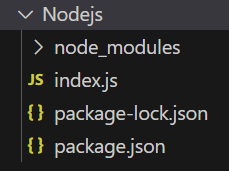
node index.jsProject Structure:
Example 1: Checking an Accepted Encoding
const express = require('express');
const app = express();
const PORT = 3000;
app.get('/', (req, res) => {
    const encoding = req.acceptsEncodings('gzip');
    console.log(encoding);
    res.send(`Accepted encoding: ${encoding}`);
});
app.listen(PORT, () => {
    console.log(`Server listening on PORT ${PORT}`);
});
Steps to run the program:
Run the index.js file using the below command:
node index.jsOutput:
Console Output:
Server listening on PORT 3000Browser Output:
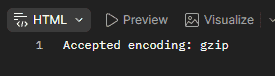
Now make a GET request to http://localhost:3000/ with the header set to 'Accept-Encoding: gzip', then you will see the following output on your browser:
Console Output:

Example 2: Checking Multiple Encodings
const express = require('express');
const app = express();
const PORT = 3000;
app.get('/', (req, res) => {
    const encoding = req.acceptsEncodings(
        'br',
        'gzip',
        'deflate'
    );
    console.log(encoding);
    res.send(`Accepted encoding: ${encoding}`);
});
app.listen(PORT, () => {
    console.log(`Server listening on PORT ${PORT}`);
});
Steps to run the program:
Run the index.js file using the below command:
node index.jsNow make a GET request to http://localhost:3000/ with the header set to 'Accept-Encoding: gzip', then you will see the following output on your browser:
Output:
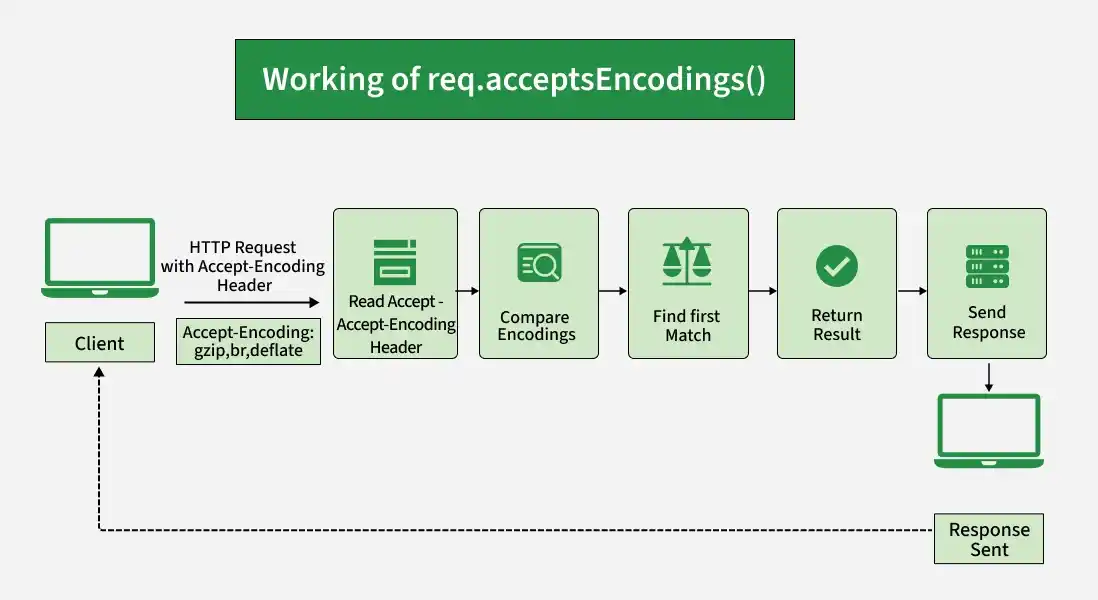
Working of req.acceptsEncodings()
- The client sends an HTTP request with an Accept-Encoding header.
- Express reads the content encodings specified in the header.
- req.acceptsEncodings() compares the requested encodings with the values provided to the method.
- Express returns the first matching encoding.
- If none of the specified encodings is acceptable, it returns false.
Use Cases of req.acceptsEncodings()
- Checking which content encodings the client supports.
- Selecting an appropriate compression format for a response.
- Supporting content negotiation based on client preferences.
- Handling different encodings such as gzip, br, and deflate.
- Optimizing response size and network performance.
Reference: https://expressjs.com/en/4x/api.html#req.acceptsEncodings
