The following is an excerpt from LIFE’s new special edition, 1968: The Year That Changed the World, available in the TIME Shop, on Amazon and at retailers everywhere.
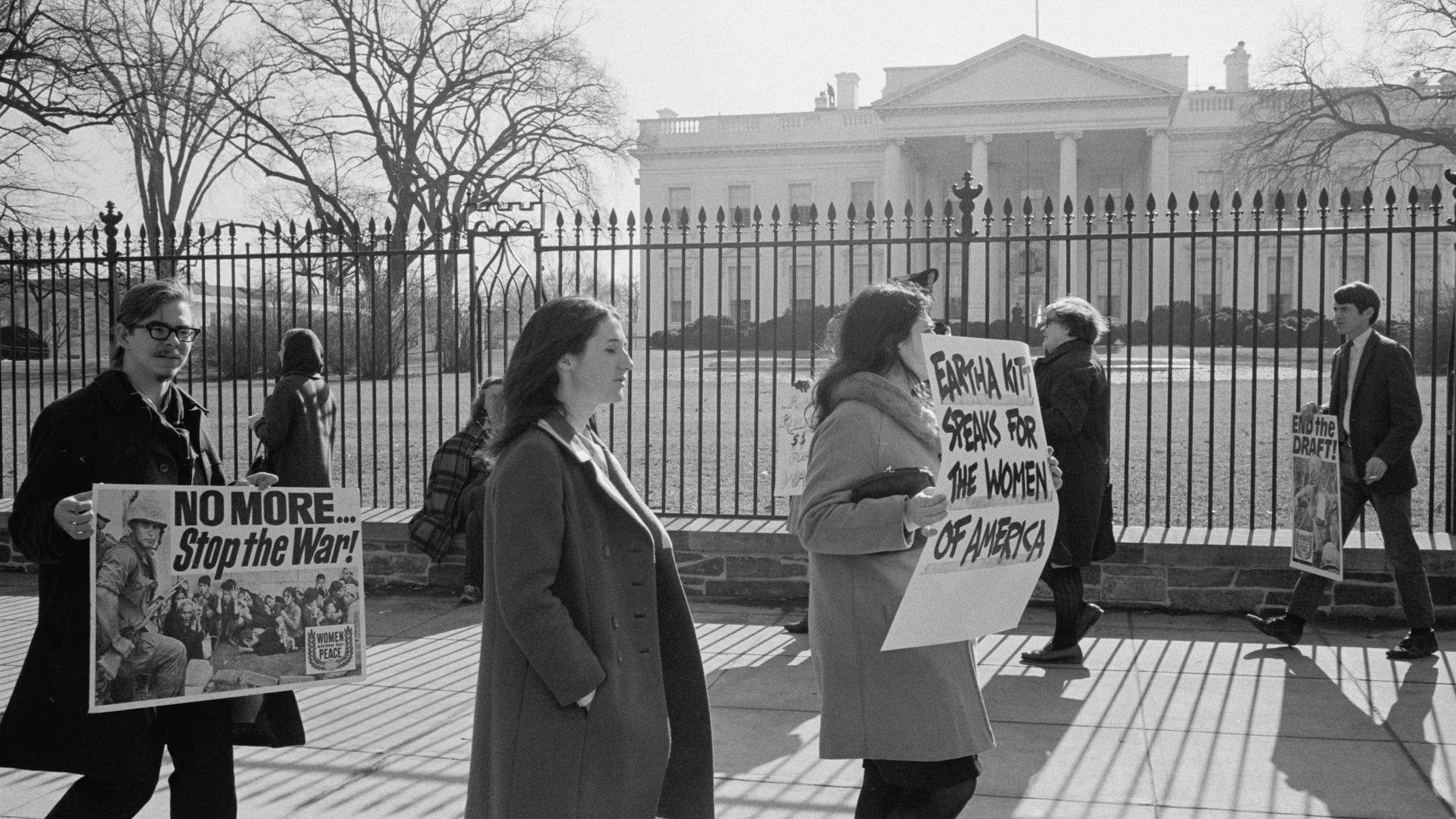
Protestors massed outside the White House at all hours. They circled alongside the fence, carrying signs reading “Stop the War,” “Bring the GIs Home Now,” and “We Mourn Our Soldiers, They Are Dying in Vain.” As the protesters walked, some handed out flyers, flashed peace signs, and held candles. Their chanting was so loud that they could be heard inside the executive mansion. “There aren’t enough walls to isolate you from that,” Lyndon Johnson’s younger daughter, Luci, later recalled of the constant refrains of “Hey, hey, LBJ, how many kids did you kill today?”
Advertisement
Soon the voices of protest reached inside the White House’s staterooms, too. When the singer and Batman star Eartha Kitt attended a White House luncheon at which Johnson spoke, she stood up and scolded the commander in chief. “You send the best of this country off to be shot and maimed,” Kitt said. “They rebel in the streets. They don’t want to go to school because they’re going to be snatched off from their mothers to be shot in Vietnam.”
While personally affronted that Kitt would so publicly criticize him in the White House, Johnson knew why people protested. He knew why they begged for their fathers, sons, brothers, and boyfriends to come home from Vietnam. Both of his daughters’ husbands were serving there. Luci’s husband, Patrick Nugent, served in the Air National Guard, and Lynda’s husband, Captain Charles Robb, commanded a Marine rifle company. “To the Johnsons’ credit, their family had put their money where their commander in chief’s mouth was,” historian Mark Updegrove tells LIFE. Even so, says Updegrove, the President deeply believed that he had to keep his nation fighting, because “sometimes you have to take a stand, that you cannot take liberty for granted.”
Advertisement
As America’s military presence grew, so did the parallel battle for peace. It had been growing since the 1964 Gulf of Tonkin Resolution and Johnson’s subsequent call for the Operation Rolling Thunder bombing campaign. Civil rights groups such as the Students for a Democratic Society (SDS) and the Free Speech Movement had held teach-ins and marched in Washington and elsewhere. Young men publicly burned their draft cards. The New Left dubbed the United States “Amerika,” and the underground press disseminated antiwar information through their own news services.
It wasn’t just leftist students and hippies who opposed the war. Many people were against it because there was no sense that the United States could win. That’s what gave rise to the organization Vietnam Veterans Against the War and what inspired Jeannette Rankin, the first woman elected to congress, to lead 5,000 women in a march to the Capitol. A financial brokerage house, Paine Webber, Jackson & Curtis, went so far as to run an ad saying that peace in Vietnam would be “the most bullish thing that could happen to the stock market.”
Eugene McCarthy’s entry into the 1968 presidential race gave a huge boost to the antiwar movement, and the battles of Khe Sanh and the Tet Offensive changed the minds of many, as Americans came to the realization that the North Vietnamese refused to be worn down. While a March 1967 poll had shown that more than half of Americans supported the way Johnson was handling the war, by early 1968 that proportion was down to about a third. The antiwar movement became more grounded in political analysis than in the starry-eyed assurance of earlier protesters, Anthony DeCurtis tells LIFE. “It was about capitalism and about something that needed to be overthrown,” he says, “and not by consciousness.”
Protests spread, and schools served as major centers of agitation. This was encouraged by the Johnson administration’s decision to abolish draft deferments for most graduate students, a move that affected some 650,000 men. Muhammad Ali, who had been banned from boxing because he refused the draft, toured campuses, giving hundreds of speeches.
Advertisement
At Harvard Law School, professor Alan Dershowitz taught a class on legal ways to resist the draft. Students there, as well as at Radcliffe and Boston University, took part in a four-day hunger strike against the war. And at Columbia, 3,500 students and 1,000 faculty members boycotted classes in protest. SDS members led by undergraduate Mark Rudd voiced their opposition to the school’s involvement with the Institute for Defense Analysis and weapons research for the military, while also fighting the school over the construction of a new gym that they complained offered discriminatory access to Harlem neighborhood residents. They also took over school buildings and occupied the president’s office. When 1,000 New York policemen descended on Columbia’s campus to clear out the protesters, that response resulted in many injuries and 700 arrests.
Agitation spread to hundreds of schools. A Milwaukee Journal survey found that 75 percent of students supported organized protest as a “legitimate means of expressing student grievances.” And some abandoned the Gandhian principles of nonviolence championed by Martin Luther King Jr. There were three arson attacks at Southern Illinois University by those opposing the war. Students at many universities also opposed recruitment by firms profiting from the war and protested their universities’ investments in companies such as Dow Chemical, which made napalm, a jelly gasoline that was used in Vietnam in firebombs and flamethrowers.
Advertisement
Some of those opposed to the war raided draft offices. Father Daniel Berrigan and eight other members of the Catholic Church entered the Selective Service office in Catonsville, Maryland, and seized hundreds of draft files. Outside, they doused the cards with their own homemade napalm. A group that became know as the Milwaukee 14 broke into that city’s Selective Service office and took 4,000 class 1-A draft cards, dragging them out in sacks and burning them in a park across the street.
LIFE Books
