


Spring 概述
- Spring是一个企业级开发框架,关注点在于软件设计层面
- Spring 已经成为Java 领域的行业标准
- Spring提供了各个层面的解决方案,SpringMVC、SpringData、Spring Cloud
- Spring 两大核心机制 loC(控制反转)、AOP(面向切面)
spring体系结构
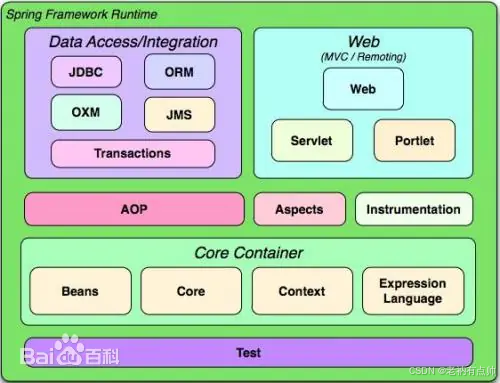
Spring框架至今已集成了20多个模块,这些模块分布在以下模块中:
- 核心容器(Core Container)
- 数据访问/集成(Data Access/Integration)层
- Web层
- AOP(Aspect Oriented Programming)模块
- 植入(Instrumentation)模块
- 消息传输(Messaging)
- 测试(Test)模块
Spring体系结构如下图:
Spring的优点
- 低侵入式设计
- 独立于各种应用服务器
- 依赖注入特性将组件关系透明化,降低了耦合度面向切面编程特性允许将通用任务进行集中式处理
- 与第三方框架的良好整合
Spring 框架两大核心机制(IoC、AOP)
- 控制反转(IoC:Inversion of Control)/依赖注入(Dl:Dependency Injection)
- 面向切面编程(AOP:Aspect Oriented Programming)
Spring,是一个企业级开发框架,是软件设计层面的框架,优势在于可以将应用程序进行分层,开发者可以自主选择组件。
MVC:Struts2、Spring MVC
ORMapping: Hibernate、MyBatisI Spring Data
什么是控制反转
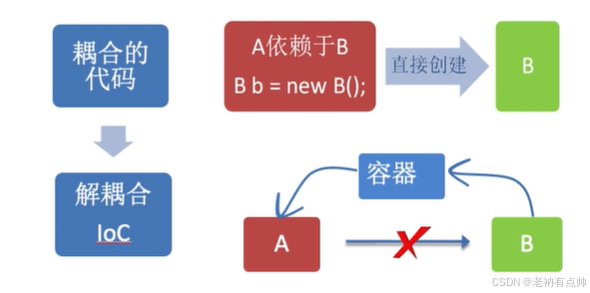
在传统的程序开发中,需要调用对象时,通常由调用者来创建被调用者的实例,即对象是由调用者主动new出来的。
但在 Spring框架中创建对象的工作不再由调用者来完成,而是交给loC容器来创建,再推送给调用者,整个流程完成反转,所以是控制反转。
如何使⽤IoC
- 创建Maven⼯程,pom.xml添加依赖
<?xml version="1.0" encoding="UTF-8"?>
<project
        xmlns="http://maven.apache.org/POM/4.0.0"
        xmlns:xsi="http://www.w3.org/2001/XMLSchema-instance"
        xsi:schemaLocation="http://maven.apache.org/POM/4.0.0
http://maven.apache.org/xsd/maven-4.0.0.xsd">
    <modelVersion>4.0.0</modelVersion>
    <groupId>com.southwind</groupId>
    <artifactId>aispringioc</artifactId>
    <version>1.0-SNAPSHOT</version>
    <dependencies>
        <dependency>
            <groupId>org.springframework</groupId>
            <artifactId>spring-context</artifactId>
            <version>5.0.11.RELEASE</version>
        </dependency>
    </dependencies>
</project>- 创建实体类Student
package com.southwind.entity;

import lombok.Data;

@Data
public class Student {
    private long id;
    private String name;
    private int age;
}- 传统的开发方式,手动 new Student
Student student = new Student();
student.setId(1L);
student.setName("张三");
student.setAge(22);
System.out.println(student);- 通过 IoC 创建对象,在配置文件中添加需要管理的对象,XML 格式的配置文件,文件名可以自定义【要放在resources包里面】。
<?xml version="1.0" encoding="UTF-8"?>
<beans xmlns="http://www.springframework.org/schema/beans"
       xmlns:xsi="http://www.w3.org/2001/XMLSchema-instance"
       xmlns:context="http://www.springframework.org/schema/context"
       xmlns:p="http://www.springframework.org/schema/p"
       xsi:schemaLocation="http://www.springframework.org/schema/beans http://www.springframework.org/schema/beans/spring-beans-3.2.xsd
    http://www.springframework.org/schema/context http://www.springframework.org/schema/context/spring-context-4.3.xsd
">

    <bean id="student" class="com.southwind.entity.Student">
        <property name="id" value="1"></property>
        <property name="name" value="张三"></property>
        <property name="age" value="22"></property>
    </bean>

</beans>- 从 IoC 中获取对象,通过 id 获取。
//加载配置文件
ApplicationContext applicationContext = new ClassPathXmlApplicationContext("spring.xml");
Student student = (Student) applicationContext.getBean("student");
System.out.println(student);
配置文件
-
通过配置
bean标签来完成对象的管理。-
id:对象名。 -
class:对象的模版类(所有交给 IoC 容器来管理的类必须有无参构造函数,因为 Spring 底层是通过反射机制来创建对象,调用的是无参构造)
-
-
对象的成员变量通过
property标签完成赋值。name:成员变量名。value:成员变量值(基本数据类型,String 可以直接赋值,如果是其他引用类型,不能通过 value 赋值)ref:将 IoC 中的另外一个 bean 赋给当前的成员变量(DI)
<bean id="student" class="com.southwind.entity.Student">
    <property name="id" value="1"></property>
    <property name="name" value="张三"></property>
    <property name="age" value="22"></property>
    <property name="a



 扫一扫
扫一扫


 2万+
2万+

 被折叠的 条评论
为什么被折叠?
被折叠的 条评论
为什么被折叠?
 到【灌水乐园】发言


